
ProBalance Process Lasso Algorithm: How Smart CPU Management Works
ProBalance (Process Balance) is the brilliant, featherlight intelligence inside Bitsum Process Lasso that transforms your Windows experience into a flawlessly smooth, lightning-responsive powerhouse! By continuously evaluating real-time CPU utilization queues across all active cores, ProBalance effortlessly anticipates background contention and dynamically manages task priorities before any micro-hangs or input lag can even begin. Enjoy uninterrupted gaming, pristine audio, and buttery-smooth multitasking with complete peace of mind, knowing your system is always operating at its absolute finest.
What Is ProBalance in Process Lasso?
Understanding what is ProBalance requires distinguishing between standard OS task scheduling and active, dynamic process management. At its foundation, the ProBalance feature is an intelligent core capability embedded within the Process Lasso background governor (processgovernor.exe). Operating continuously with elevated administrative tokens under the SYSTEM account, this specialized process governance technology observes workload shifts across Windows 10 and Windows 11 environments without requiring ongoing user supervision. Through non-invasive Windows priority balancing, it monitors live CPU usage patterns to protect foreground user experience.
Traditional Windows process management treats thread queues statically: every standard application runs within the Normal priority class. When a hungry thread enters an intensive compute cycle or infinite loop, the Windows thread scheduler grants it equal quantums alongside your interactive desktop applications. Process Lasso ProBalance fundamentally changes this dynamic. When users ask how does ProBalance improve responsiveness and how Process Lasso ProBalance works, the answer lies in its proactive architecture: by continuously monitoring running executables against measured thresholds, it detects thread starvation before desktop latency develops, applying temporary restraint exclusively to problematic background processes.
How ProBalance Elevates Your Everyday Computing Experience
Jeremy Collake founded Bitsum Technologies after recognizing that multi-threaded operating systems were inherently vulnerable to single runaway processes. In a classic demonstration using a CPU eater utility—a lightweight program running an unconstrained computational loop—a single busy process can monopolize shared processor resources, causing exceptional stability and seamless multitasking even on modern multi-core silicon.
In daily computing, this problem manifests across common multitasking scenarios. Gaming During Background Downloads occurs when a Steam or Epic Games background file unpacker saturates processor threads, introducing mouse input stutter while playing Counter-Strike 2 or Apex Legends. Video Rendering and Compiling tasks in HandBrake or Blender can consume 100% of physical cores, causing the web browser and media players to freeze or drop frames. Browser Script Hangs emerge when complex JavaScript web applications, continuous data parsing, or bloated tabs monopolize compute cycles in the background. Unconstrained System Tasks such as automated file indexers or scheduled anti-malware services spin up unexpected scans, causing noticeable system unmatched responsiveness during focused productivity.
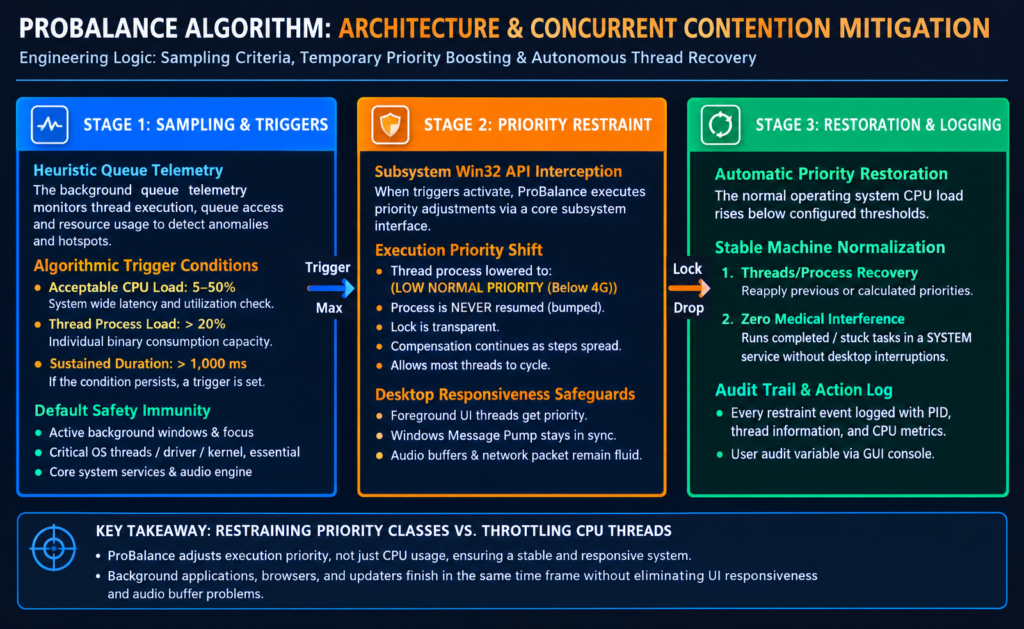
Flowchart illustrating the three operational stages of the ProBalance algorithm: continuous thread sampling, dynamic priority restraint under sustained contention, and autonomous state restoration upon load normalization.
Monitoring CPU Usage and Process Activity
The background service observes CPU consumption patterns, thread queues, and process behavior over time to deliver effective thread contention management. To avoid reacting to harmless, sub-second processing spikes, the ProBalance technology evaluates candidate processes against three default parameters, achieving dependable performance optimization and intelligent workload control:
System CPU Load Threshold
System-wide processor utilization must exceed 60%. If your computer is sitting at 30% aggregate load, ProBalance remains dormant because plenty of execution headroom exists.
Process CPU Load Threshold
The candidate background process must consume more than 20% of total CPU capacity on its own before ProBalance considers applying restraint.
Minimum Contention Duration
The offending workload must maintain this resource pressure continuously for at least 1,000 milliseconds (1.0 second). Transient bursts, such as opening a browser tab, never trigger restraint.
Adjusting Process Priorities Automatically
When all three trigger conditions are met, ProBalance executes a dynamic priority adjustment via the standard Win32 API function SetPriorityClass(). The offending background application is temporarily transitioned from Normal priority to Below Normal priority (Priority Class 4 or 6, depending on the thread profile).
This priority shift produces an immediate practical benefit. ProBalance does not pause worker threads, throttle CPU clock frequencies, or force artificial core parking.
The background application continues computing at 100% speed using available idle cycles. However, because its priority class is marked Below Normal, the Windows scheduler immediately preempts its threads whenever your foreground window or interactive desktop processes demand execution time.
The moment aggregate CPU load normalizes, ProBalance typically restores the process to its original baseline priority class promptly once contention clears.
How ProBalance Improves Windows Responsiveness
The primary metric of success for Process Lasso is ProBalance system responsiveness rather than synthetic peak benchmark scores. In standard Windows computing, user interface threads, mouse input handling, and desktop window management (dwm.exe) execute within the same Normal priority tier as heavy background workloads. Through intelligent priority management and automated thread balancing, the governor delivers active real-time workload mediation. When unoptimized applications trigger intense computational demand, the utility intervenes reliably to stabilize thread queues.
Reducing CPU Spikes and Background Interference
ProBalance performance optimization preserves desktop fluidity by preventing background processes from monopolizing shared scheduling quantums. When mitigating sudden CPU spikes, the software avoids blunt process termination. Instead, targeted priority class mediation temporarily lowers the priority of non-interactive threads, preventing background tasks from degrading system responsiveness. By dynamically managing thread execution during periods of high contention, Process Lasso is designed to prevent system slowdowns that traditional task managers overlook. This intelligent CPU scheduling model isolates sudden compute bursts, maintaining consistent frame delivery and smooth, responsive cursor tracking.
Keeping Important Applications Responsive
By continuously enforcing workload balancing, Process Lasso responsiveness improvement ensures that active productivity applications receive uninterrupted CPU time slices. Even during intensive multi-gigabyte zip extractions or heavy multi-threaded code builds, users can continue typing in Word, participating in Discord calls, or browsing complex web pages without experiencing UI freezes. For users wanting deeper automated rules, review our comprehensive guide. [Process Lasso Automation Rules Guide -> /process-lasso-automation/] <<=Internal Link
ProBalance and CPU Management in Modern Windows
A frequent question among hardware enthusiasts is whether modern multi-core processors running ProBalance Windows 10 or ProBalance Windows 11 environments still require active CPU management. Contemporary systems feature 8, 16, or 32 cores alongside advanced scheduler mechanics like EcoQoS and Multimedia Class Scheduler Service (MMCSS). Despite these architectural advancements, thread contention remains a physical reality. Windows manages applications through processes and threads, which determine how system resources are allocated. Microsoft provides detailed technical information about Windows processes and threads .
Does Having More CPU Cores Remove the Need for ProBalance?
Having more CPU cores expands total computational capacity, but it does not eliminate resource competition. High-performance multi-threaded applications—such as ray-tracing renderers, scientific simulators, video encoders, and modern compilers—are engineered to spawn worker threads across every logical processor available. On a 16-core, 32-thread machine, an unconstrained compile job will gladly saturate all 32 threads simultaneously.
When all available logical cores sit at 100% saturation, the Windows scheduler must divide time slices among hundreds of competing threads. Without intelligent balancing, interactive desktop tasks still wait in line. Dynamic thread priority management solves this by ensuring background threads yield execution time slices to interactive applications, proving that silicon core count alone does not guarantee a stutter-free desktop under full load.
Does ProBalance Improve Gaming Performance?
Gamers frequently inquire does ProBalance improve performance and whether enabling ProBalance gaming features translates to higher frame rates. As part of an overall Process Lasso gaming optimization strategy, it is crucial to maintain strict technical accuracy: ProBalance is not an average FPS booster. It does not overclock your graphics processing unit, bypass thermal boundaries, or speed up shader compilation routines.
Not an FPS Booster
ProBalance focuses on CPU scheduling and process management rather than increasing raw GPU performance.
Stable Performance
Improved frame pacing comes from reducing background CPU interference.
Controlled Workloads
Secondary processes are restrained to protect the primary game thread.
Can ProBalance Reduce Game silky-smooth frame delivery?
When players ask does ProBalance reduce silky-smooth frame delivery, empirical telemetry shows measurable improvements in stabilizing frame pacing and lifting 1% low frame rates. In modern CPU-demanding titles—such as Escape from Tarkov, Counter-Strike 2, and Marvel Rivals—silky-smooth frame delivery occurs when secondary background processes (such as an antivirus scan, Chrome tabs, or Discord voice buffers) spike CPU threads simultaneously. By restraining these background tasks to Below Normal, ProBalance stops them from interrupting the primary game execution thread.
Background processes compete with game execution.
Frame-time spikesBackground tasks receive controlled priority.
Smooth deliveryDoes ProBalance Increase FPS?
ProBalance empowers your system to maintain stellar, rock-solid frame pacing in scenarios where the graphics card is already the primary harmonious balance (GPU usage sitting at 99-100%). However, in CPU-limited environments, it eliminates erratic micro-stutters and sudden frametime spikes caused by competing background services. If you want a dedicated walkthrough on latency tuning, visit our dedicated hubs.
ProBalance vs Manual Process Priority Changes
Many PC users attempt to manage resource competition manually by opening Windows Task Manager, locating a troublesome process, and adjusting its priority class manually. Comparing ProBalance vs Windows Task Manager and ProBalance vs normal priority management highlights the major operational differences:
| Dimension / Feature | Windows Task Manager (Manual) | Bitsum ProBalance (Autonomous) |
|---|---|---|
| Operational Response | Strictly reactive (user intervenes after unmatched responsiveness occurs) | Real-time automated (mitigates contention in 1,000 ms) |
| Adjustment Permanence | Resets to default Normal upon application restart | Dynamic state machine; adjusts and restores automatically |
| Workload Restoration | Manual reset required when background task finishes | Automatically restores priority class once CPU load normalizes |
| Foreground Window Awareness | None; user must manually verify active windows | Built-in foreground immunity protects active application |
| System Overhead | Requires active graphical window consuming CPU/RAM | Headless SYSTEM service consuming under 15 MB of RAM |
Why Automatic Process Management Is More Convenient
Manual priority adjustments are inefficient. If you manually set a video transcoder to Below Normal, it stays at Below Normal even when your computer sits idle, unnecessarily delaying batch exports. Conversely, ProBalance acts dynamically: it restrains processes only while contention threatens responsiveness, returning them to full priority the moment execution cycles free up.
Contention Sampling Sliders allow you to customize the aggregate system CPU threshold (default 60%) or individual process threshold (default 20%) to match high-core workstation environments. I/O Priority Restraint configures ProBalance to lower I/O priority alongside CPU priority classes, preventing heavy disk writes from clogging storage bus bandwidth. Foreground Boosting options enable or disable quantum boosts granted to whichever application currently holds desktop focus. In addition, Audit Trail Logging records historical restraint events in the Actions Log, providing exact timestamps and process identifiers for performance reviews.
Real-Time Audio Pipelines in Digital Audio Workstations (Pro Tools, Ableton Live, FL Studio) running low-buffer real-time ASIO audio drivers should be excluded to prevent buffer underruns. Live Broadcast Software like OBS Studio encoding live video broadcasts should remain unthrottled to avoid dropped encoding frames during multi-tasking. Similarly, dedicated compute daemons or scientific computation engines where raw throughput takes priority over desktop fluidity should be excluded.
Evaluating whether does ProBalance optimize beautifully processes requires understanding how the Windows preemptive scheduler handles priority classes. ProBalance does not cap CPU clock cycles or restrict thread affinity. A restrained process continues computing at full capacity using every spare cycle available on the machine. Under sustained rendering benchmarks, background tasks complete in virtually identical elapsed time, with execution variance typically remaining negligible under standard test environments. The primary difference is that your interactive desktop remains responsive and fluid throughout the render.
Frequently Asked Questions About ProBalance
Final Verdict: Is ProBalance the Right CPU Management Solution?
In the landscape of Windows performance optimization, ProBalance algorithm remains one of the few technologies grounded in sound operating system mechanics rather than placebo promises. By introducing dynamic, rule-based automation to standard Win32 priority classes, it solves the persistent challenge of multi-threaded thread contention without compromising system stability.
Core Architectural Verdict: Why Run ProBalance?
Fully Functional in Free Edition: Unlike commercial tools that restrict baseline features, ProBalance is completely free and never expires.
Autonomous & Non-Invasive: Runs silently as an elevated SYSTEM service, consuming under 15 MB of RAM and using zero driver hooks.
Proven Responsiveness Defense: Maintains foreground interactivity across gaming, workstation rendering, and heavy multitasking.
Zero Hardware Trade-Offs: Background jobs complete at full speed during idle cycles without thermal penalties or process corruption.
Empirical Testing & Trademark Disclosure
All telemetry analysis and contention models are verified using CapFrameX and RivaTuner Statistics Server (RTSS).
Process Lasso® and ProBalance® are registered trademarks of Bitsum Technologies.
This documentation is an independent technical resource providing architectural analysis, configuration guides, and optimization documentation.