
Process Lasso Changelog & Release Notes: Version History and Updates
Tracking software updates is essential to maintaining a responsive, stable Windows environment, and this comprehensive Process Lasso changelog provides a complete update tracker for power users and administrators. A detailed changelog offers full transparency into how the software evolves, detailing every bug fix, security patch, algorithmic refinement, and feature rollout Bitsum introduces. Reviewing release notes before updating helps you understand underlying system changes, evaluate potential compatibility adjustments, and decide whether a new build addresses specific performance bottlenecks on your machine. Unlike generic patch summaries, this page delivers user-focused explanations of ongoing improvements in Windows process management, background workload priority control, and real-time thread scheduling.
How to Rollback Process Lasso Version
If a recent update introduces an unexpected conflict or edge-case bug on your specific hardware configuration, rolling back to a previous stable build is straightforward:
| Version | Release Date | Status | Highlights |
|---|---|---|---|
| v18.3.0.34 | September 2026 | Stable | Expanded GPU telemetry metrics, refined ProBalance scheduling loops, and enhanced graph rendering performance. |
Current Stable Version Overview
The current stable release represents the pinnacle of reliability, having undergone rigorous validation across diverse Windows 10 and Windows 11 hardware configurations. Stable versions are strongly recommended for most users, including gamers, developers, and enterprise administrators who prioritize absolute system uptime over experimental features. Unlike test builds, stable releases are vetted to prevent unexpected edge-case conflicts with third-party anti-cheat software, kernel-level drivers, and background monitoring utilities.
Full compatibility is maintained across modern multi-core architectures, ensuring seamless execution on both traditional desktop processors and hybrid chips utilizing performance and efficiency cores.
Recent Changes and Improvements
Recent updates focus heavily on tightening background thread responsiveness while minimizing the software’s own resource footprint. Instead of obscure developer shorthand, the real-world impact for everyday operators includes significantly smoother multi-tasking under heavy workloads and more intuitive hardware telemetry visualization. Process enumeration handling has been fundamentally streamlined, meaning the utility detects and displays running applications faster and with greater reliability. Memory management routines, including SmartTrim triggers, have also been fine-tuned to release inactive working sets without inducing stutter during active foreground tasks.
Should Gamers Update Process Lasso?
For competitive and casual gamers, keeping Process Lasso updated is highly recommended, especially when playing titles that demand stable frame rates and minimal 1% lows. Version 18 introduced advanced multi-GPU tracking and enhanced ProBalance Algorithms that prevent background application spikes from stealing CPU cycles away from active game sessions. Updating ensures you avoid micro-stutters caused by background launchers, Discord overlays, or anti-cheat synchronization routines. Gamers can also optimize their systems further using recommended Process Lasso Best Settings for Gaming.
Should You Update Process Lasso Before Windows Update?
Major Windows cumulative updates and biannual feature upgrades frequently alter thread scheduling behaviors, DWM rendering pipelines, and kernel hooks. Updating Process Lasso immediately before or alongside a major Windows patch guarantees that you have the latest compatibility fixes. Bitsum regularly rolls out maintenance patches specifically tailored to align with Microsoft’s OS build modifications, preventing conflicts between the Process Lasso governor and Windows security baselines. Microsoft regularly documents Windows updates, system changes, and operating system compatibility considerations through its official Windows release health resources.
Latest Process Lasso Release
Staying informed about the newest software iteration ensures your system benefits from the latest performance breakthroughs and stability patches. The table below outlines the current release metrics for the software:
Where to Download Older Versions
Official previous versions and historical builds can be accessed directly through Bitsum’s legacy release channels or verified software archives such as Uptodown and Softonic. Always ensure you download legacy binaries from official or trusted mirrors accompanied by clean antivirus scan reports to prevent downloading compromised installer packages.
Process Lasso Version History
Examining the historical evolution of the software reveals a clear trajectory toward deeper hardware integration and finer-grained control over Windows NT thread scheduling. Major version milestones have transformed the utility from a basic priority regulator into an advanced automated governor capable of managing complex CPU affinities, core parking states, and GPU metrics
Process Lasso v18.x Releases
Version 18 introduces a major leap forward in hardware telemetry, bringing native multi-GPU support and advanced graphical monitoring directly into the main interface. The v18.x cycle focuses on bridging the gap between CPU and GPU workload management, allowing power users to monitor hardware bottlenecks without launching auxiliary diagnostic tools. Interface aesthetics have received a thorough modernization pass, offering crisper graphs, customizable color themes, and a consolidated rules view that simplifies complex automation setups.
Process Lasso v17.x Release History
Version 17 established robust multi-core management and consolidated rule views. Notable releases within this branch include:
Process Lasso v16.x Release History
Version 16 focused on hardware-level priority enforcement and streamlined configuration portability.
Process Lasso v15.x Release History
Version 15 laid the groundwork for advanced core selection and background process isolation.
Process Lasso Release Notes
Detailed release notes break down technical modifications version by version, ensuring transparency for advanced administrators who manage multiple Windows endpoints.
New Features and Enhancements
Newly introduced functionalities focus on automated system governance and proactive responsiveness protection. Recent tools include smarter watchdog triggers that react instantly to runaway background processes, as well as enhanced GUI controls for manual thread manipulation. These enhancements translate directly to a more fluid desktop experience, preventing runaway background tasks from starving foreground applications of critical CPU cycles.
Bug Fixes and Performance Improvements
Stability fixes and crash prevention updates form the backbone of every minor software revision. Resolving handling adjustments have successfully resolved rare memory leaks associated with prolonged logging sessions, while compatibility patches ensure smooth operation alongside major Windows cumulative updates. These refinements guarantee that continuous background monitoring remains lightweight and entirely unnoticeable during day-to-day computing.
Compatibility and System Updates
Bitsum maintains rigorous compatibility standards across supported Windows versions, including deep integration with Windows 11 scheduling quirks. Hardware support updates ensure optimal interaction with modern asymmetric core layouts, preventing scheduling conflicts on modern silicon. Driver components and system hooks are routinely updated to comply with strict kernel security requirements without sacrificing optimization efficacy.
Process Lasso Beta Builds and Experimental Releases
For enthusiasts who want early access to cutting-edge features before they hit the stable branch, experimental builds offer a glimpse into the future of Windows optimization.
What Are Process Lasso Beta Builds?
Beta versions contain upcoming changes, experimental algorithms, and newly developed interface elements still undergoing active testing. They allow power users to test upcoming features early and provide feedback to developers. However, because these builds may include unfinished improvements or undiscovered edge-case bugs, they are strictly recommended for advanced users, testing environments, and enthusiasts who enjoy living on the bleeding edge rather than mission-critical production workstations.
Stable Release vs Beta Version
| Feature | Stable Version | Beta Version |
|---|---|---|
| Reliability | Higher, thoroughly vetted for daily use | Active testing phase, potential minor bugs |
| New Features | Released after extensive validation | Available early for testing |
| Recommended Users | Everyday users, gamers, and professionals | Advanced users, testers, and enthusiasts |
What’s New in Process Lasso v18?
Version 18 represents a watershed moment for the software, packing massive architectural updates tailored for modern multi-core hardware and complex multi-GPU setups.
Major Features Introduced in v18
The headline addition in v18 is comprehensive multi-GPU support, allowing users to track GPU loads alongside traditional CPU metrics. Improved monitoring graphs and streamlined rule imports make managing complex automation profiles faster than ever before.
Improvements to Performance and User Experience
Under the hood, v18 features cleaner execution loops that reduce idle overhead and speeds up interface rendering. Usability refinements streamline the process of creating persistent rules, ensuring that custom configurations apply instantly across system reboots.
Process Lasso Update Timeline
| Version | Date | Major Update |
|---|---|---|
| v18.x | Recent | Multi-GPU support, refreshed graph aesthetics, and expanded telemetry. |
| v17.x | Historical | Consolidated rules view and improved hybrid core handling. |
Major Version Milestones
Milestone releases have consistently pushed the boundaries of what automated software can achieve on Windows. From the introduction of the proprietary ProBalance algorithm to modern GPU metrics and core parking overrides, each major version has redefined software-based responsiveness.
Important Maintenance Updates
Minor maintenance patches play a critical role in day-to-day reliability, delivering targeted security improvements, minor bug fixes, and swift compatibility adjustments whenever Microsoft rolls out major operating system patches.
How to Check Your Process Lasso Version
Verifying your currently installed build number takes only a few seconds through the graphical interface:
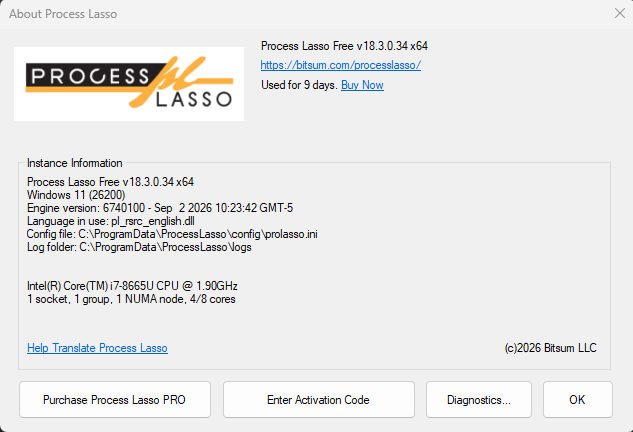
Figure: Process Lasso About dialog box displaying the exact version number, build, and system architecture.
Should You Update Process Lasso?
Deciding whether to update depends heavily on your current system stability and your desire for new features. You should update immediately if your current version exhibits known bugs, if you require compatibility fixes for a recent Windows update, or if you want access to newly introduced optimization algorithms. Conversely, if your system is operating with flawless stability and you lack the time to test new configurations, staying on your current stable version is a valid approach.
Frequently Asked Questions
Final Verdict: Should You Keep Process Lasso Updated?
Keeping Process Lasso updated ensures your system maintains access to the latest performance improvements, security enhancements, and compatibility patches. For everyday users and gamers, sticking with the latest stable release guarantees maximum reliability. Advanced users and testers can leverage beta builds to explore upcoming features early, while anyone troubleshooting system quirks should review recent patch notes to see if a known issue has already been resolved.