
What Are Process Lasso Algorithms?
Process Lasso Algorithms represent a specialized suite of automated routines engineered to solve the inherent limitations of default Windows NT thread scheduling. Through a comprehensive Process Lasso algorithm explained technical overview, Process Lasso optimization algorithms explained monitor real-time CPU contention and dynamically adjust process priorities, core allocations, and resource limits utilizing Process Lasso internal algorithms and Process Lasso technical overview principles.
How Process Lasso Works Behind the Scenes
How Process Lasso works is driven by its robust Process Lasso optimization technology and Process Lasso optimization engine. The software operates through a client-governor architecture where a lightweight background service (processgovernor.exe running under the SYSTEM account) governs system resources while the graphical interface visualizes live telemetry. This Windows optimization engine and high-performance Process Lasso architecture interfaces directly with Windows NT kernel APIs and Win32 executive functions to execute rapid thread scheduling adjustments without introducing measurable system overhead.
Microsoft provides detailed documentation about Windows processes and thread management, which explains the underlying system architecture used for application execution.
Windows processes and threads documentationUnderstanding Process Lasso’s Intelligent Optimization System
Process Lasso intelligent optimization and the Process Lasso automatic optimization system rely on continuous heuristic sampling rather than static rules. Through Process Lasso intelligent process management, by evaluating CPU core saturation and process responsiveness in real time, the system automatically adapts to changing software demands, providing seamless background workload regulation.
How Process Lasso Manages System Performance
Process Lasso performance management and Process Lasso system optimization achieve automatic performance management by constantly balancing compute-heavy background tasks against interactive foreground windows. This active resource balancing prevents transient CPU spikes from causing noticeable micro-stutters or cursor lag.
Process Lasso ProBalance Algorithm Explained
The Process Lasso ProBalance algorithm and Process Lasso ProBalance technology stand as Bitsum’s flagship innovation, comprehensively detailed through this Process Lasso ProBalance explained guide specifically engineered to prevent rogue background applications from dragging down system responsiveness.
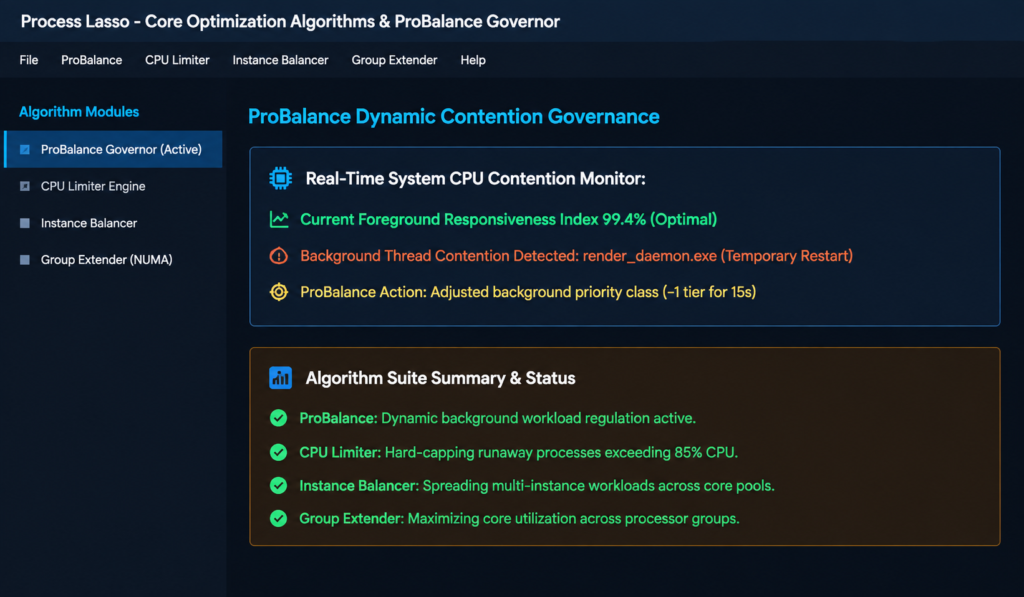
How ProBalance Works in Process Lasso How ProBalance works in Process Lasso involves dynamic contention governance: when a background application begins consuming excessive processor cycles, ProBalance detects the emerging CPU contention and temporarily restrains the offending process by lowering its priority class by a marginal amount for a short duration. As soon as the foreground application requires those CPU cycles back, ProBalance immediately restores the background process to its normal state.
How ProBalance Improves System Responsiveness Through Process Lasso responsiveness optimization, ProBalance prevents system slowdowns and utilizes advanced Process Lasso CPU responsiveness technology by proactively intervening during high-demand moments to ensure interactive applications never experience starvation.
Managing Background Activity With ProBalance Process Lasso background activity management operates entirely on autopilot (accessible via Options > ProBalance Settings), allowing operators to run intensive batch processing jobs without having to manually fiddle with Task Manager priorities.
Process Lasso CPU Limiter Algorithm
The Process Lasso CPU Limiter algorithm and Process Lasso CPU Limiter technology provide a hard enforcement mechanism for stubborn applications that ignore standard priority adjustments to cap excessive processor consumption.
How Process Lasso CPU Limiter Works
How Process Lasso CPU Limiter works involves tracking cumulative processor utilization for specified executables over rolling time windows (configurable via Options > CPU Limiter Settings or right-clicking target processes). If a target process exceeds your configured percentage threshold (e.g., 85% CPU utilization), the algorithm enforces temporary thread suspension intervals utilizing Windows NT executive scheduling APIs to cap its resource usage.
CPU Resource Balancing and Workload Management
The Process Lasso resource balancing algorithm, Process Lasso workload balancing, and Process Lasso resource management technology are invaluable for managing poorly optimized games, runaway background daemons, or crashing browser tabs that would otherwise cause thermal throttling and system instability.
Process Lasso Process Balancing Algorithms
Multi-process optimization requires sophisticated workload balancing powered by Process Lasso performance algorithms, Process Lasso performance balancing, and Process Lasso application balancing to ensure compute tasks are distributed efficiently across all available logical cores.
How Process Lasso Balances Processes How Process Lasso balances processes relies on advanced Process Lasso process balancing technology that analyzes thread distribution patterns across multi-core processors, preventing CPU bottlenecks and ensuring that multi-threaded applications scale effectively without core contention.
Multi-Process Optimization and Application Workload Balancing Through Process Lasso multi process optimization and Process Lasso application workload balancing, these performance algorithms help maximize hardware utilization across both traditional desktop processors and modern hybrid silicon architectures.
Process Lasso Instance Balancer Algorithm
When running multiple concurrent instances of the same application, the Process Lasso Instance Balancer and Process Lasso Instance Balancer algorithm ensure they do not collide or overwhelm specific processor clusters.
How Process Lasso Instance Balancer Works
How Process Lasso balances processes across instances involves detecting when multiple identical executables are spawned and automatically distributing them across distinct core pools or affinity masks, preventing localized CPU bottlenecks during heavy batch execution.
Process Lasso Group Extender Algorithm
On massive workstation platforms featuring multiple processor groups, the Process Lasso Group Extender and Process Lasso Group Extender algorithm ensure applications can utilize computing resources beyond standard Windows API limits.
How Process Lasso Group Extender Works
How Process Lasso Group Extender works—supported by Process Lasso process grouping technology—is by breaking through traditional 64-logical-core application barriers, allowing multi-threaded enterprise software and rendering engines to harness the full processing power of extreme multi-socket or high-core-count processors.
Process Lasso Optimization Features and Benefits
The synergistic combination of Process Lasso optimization features, Process Lasso advanced optimization features, and Process Lasso performance improvement technology delivers tangible performance improvements across daily desktop operations.
How Process Lasso Improves Windows Responsiveness Why Process Lasso improves Windows responsiveness stems from combining dynamic optimization, preemptive ProBalance restraint, and precise CPU limiting to dramatically enhance Windows responsiveness under heavy multitasking duress.
Dynamic Optimization and Performance Balancing Process Lasso dynamic optimization and the Process Lasso system responsiveness algorithm ensure that your PC adapts instantly to shifting workloads, maintaining maximum responsiveness without requiring constant manual tuning.