
What Are Process Lasso CPU Rules?
Process Lasso CPU Rules and Process Lasso CPU Management Rules are persistent configuration directives assigned to specific executables that dictate how the Windows NT scheduler distributes computing resources to them. By establishing Process Lasso persistent settings and Process Lasso CPU control rules, these Process Lasso CPU settings provide permanent, application-specific processor management rules that survive system reboots. This guide focuses specifically on CPU management rules, not general rules or automation features.
How Process Lasso CPU Rules Work
How Process Lasso CPU rules work involves continuous background monitoring. The background governance service continuously monitors active Windows processes against your established profile parameters. When an application initializes, the governor instantly detects the executable, matches it against your configured Process Lasso processor management rules and Process Lasso CPU configuration settings, and applies designated priority classes, affinity masks, or CPU sets within milliseconds of startup for optimal Process Lasso CPU resource management.
Process Lasso Priority Rules
Priority governance forms the baseline of application responsiveness by determining how much CPU scheduler attention a process receives relative to other active tasks.
Understanding Process Lasso Priority Classes
Windows assigns priority classes to every running process to dictate thread scheduling hierarchy. Process Lasso priorities and Process Lasso priority classes incorporate Process Lasso process priority rules to allow operators to override default operating system behavior, ensuring that interactive applications receive preferential treatment over background utilities.
High, Normal, and Low Priority Settings in Process Lasso
Configuring priority settings involves assigning specific tiers—such as the Process Lasso high priority setting, Process Lasso normal priority setting, or Process Lasso low priority setting—to target executables. Elevating priority helps prevent interface stutter during demanding tasks, while lowering background workloads protects system fluidity.
How Persistent Priority Rules Work in Process Lasso
Persistent priority rules and Process Lasso persistent priority parameters remember your customizations across sessions, automatically applying the designated priority class every time the target executable launches without requiring manual re-configuration.
Process Lasso CPU Affinity Rules
Processor affinity controls precisely which logical cores or hardware threads an application is permitted to execute upon.
What Is CPU Affinity in Process Lasso?
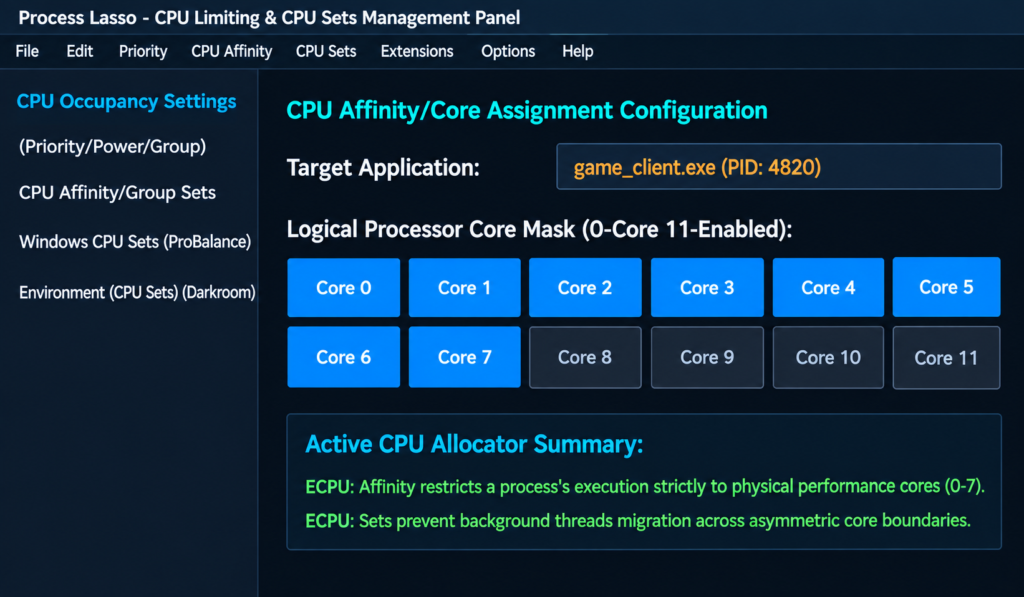
CPU affinity is a core scheduling mask that binds a process to specific logical processors, preventing the Windows scheduler from migrating its threads across the entire processor die. Utilizing Process Lasso CPU affinity settings, Process Lasso core affinity, and Process Lasso processor affinity ensures precise hardware thread binding. Microsoft provides technical documentation explaining how Windows manages processor affinity and thread execution across logical processors.
Windows processor affinity documentation
Assigning and Restricting CPU Cores in Process Lasso Restricting CPU cores and executing Process Lasso CPU core assignment via Process Lasso assign CPU cores and Process Lasso restrict CPU cores is particularly valuable on modern hybrid architectures featuring performance cores (P-cores) and efficiency cores (E-cores), allowing users to keep background tasks off primary gaming threads.
How to Set CPU Affinity in Process Lasso How to set CPU affinity in Process Lasso involves selecting the target process, opening its persistent configuration menu (by right-clicking the process and navigating to CPU Affinity > Always, or via the centralized Rules Manager), and checking the desired core affinity mask or Process Lasso affinity mask. Once saved, the background governor enforces the core restriction automatically utilizing Windows NT scheduler affinity mask APIs.
Process Lasso CPU Sets Rules
CPU sets represent a modern Windows NT scheduling mechanism that offers a softer, more flexible alternative to traditional hard affinity masks.
What Are CPU Sets in Process Lasso?
Process Lasso Windows CPU Sets and Process Lasso CPU Sets settings allow the operating system to distribute workload threads across a designated group of processor cores while respecting application boundaries and power efficiency constraints. Learning how Process Lasso CPU Sets work reveals an advanced scheduling mechanism.
How to Manage and Assign CPU Sets in Process Lasso
Managing CPU sets through the software interface (accessed via right-clicking an active process or through Options > CPU Sets) allows power users to Process Lasso manage CPU Sets, Process Lasso assign CPU Sets, and execute Process Lasso CPU scheduling control to group related applications into specific hardware clusters, optimizing cache locality and reducing inter-core communication latency via native Windows CPU Sets APIs.
CPU Sets vs CPU Affinity in Process Lasso
Examining Process Lasso CPU Sets vs affinity highlights the CPU Sets and CPU affinity difference: while traditional CPU affinity hard-locks an application to specific cores and can sometimes interfere with Windows thread balancing, CPU sets provide flexible scheduling guidance that allows the OS kernel to manage thread migration more gracefully within the allowed hardware boundary.
Process Lasso Reserved CPU Sets Rules
Reserving dedicated hardware resources ensures that mission-critical applications never experience CPU starvation during extreme system contention.
What Are Reserved CPU Sets in Process Lasso? Process Lasso Reserved CPU Sets, applying Process Lasso reserved CPU rules, and understanding how Reserved CPU Sets work in Process Lasso involve allocating Process Lasso reserved processor sets to isolate specific processor cores exclusively for designated high-priority applications, blocking all other non-essential background processes from utilizing those specific hardware threads.
Reserving CPU Resources for Important Applications This advanced Process Lasso CPU resource reservation technique allows you to Process Lasso reserve CPU cores and allocate Process Lasso dedicated CPU cores, making it ideal for professional audio workstations, live streaming hardware encoders, and competitive gaming rigs where absolute frame pacing and zero CPU contention are mandatory.
Advanced Process Lasso CPU Configuration
Engaging Process Lasso advanced CPU configuration allows power users to fine-tune Process Lasso processor allocation and streamline Process Lasso multi core management across complex multi-threaded environments.
Managing CPU Resources for Different Workloads
By effectively managing CPU resources for different workloads, advanced operators ensure that heavy batch processing tasks and interactive applications share silicon harmoniously without performance degradation.
Process Lasso CPU Rules for Windows Optimization
Leveraging Process Lasso CPU Rules for Windows Optimization ensures that underlying operating system scheduler mechanics operate at maximum efficiency under heavy multitasking loads.
Best Practices for Using Process Lasso CPU Rules
Adhering to configuration best practices ensures your processor management rules deliver maximum performance without inducing unintended side effects.
When Should You Use CPU Affinity Rules?
Use CPU affinity when dealing with legacy software that exhibits threading bugs on modern multi-core processors, or when strictly isolating background daemons away from primary performance cores.
When Should You Use CPU Sets Instead of Affinity?
Prefer CPU sets over hard affinity when you want to guide thread distribution across core clusters (such as P-core pools) without entirely stripping the Windows kernel of its dynamic load-balancing capabilities.
Avoiding Incorrect CPU Resource Restrictions
Avoid locking system-critical processes or essential Windows services to single cores, as over-restricting core access can lead to thread starvation and system instability.