
What Is Process Lasso and What Does It Do?
At its core, what is process lasso? Process Lasso is a specialized Windows process management software and process management utility designed to monitor running applications and apply automated rules that maintain system responsiveness. Understanding what does process lasso do involves recognizing its role as a background governor. Rather than serving as a basic task viewer, this process lasso program and process lasso software actively regulates thread priorities and CPU usage without requiring constant manual intervention.
Why Windows Process Management Can Become Challenging
Windows operates using a built-in preemptive thread scheduler designed to distribute execution time across active threads. However, under heavy computing loads—such as running compilation tasks, rendering software, or demanding games—background processes can saturate processor cores. Because standard task managers are purely reactive, users are often left trying to manually close frozen applications after system slowdowns have already occurred.
For advanced process monitoring and troubleshooting, Microsoft Process Explorer documentation provides detailed information about running processes, resource usage, and system activity.
How Process Lasso Works Alongside Windows
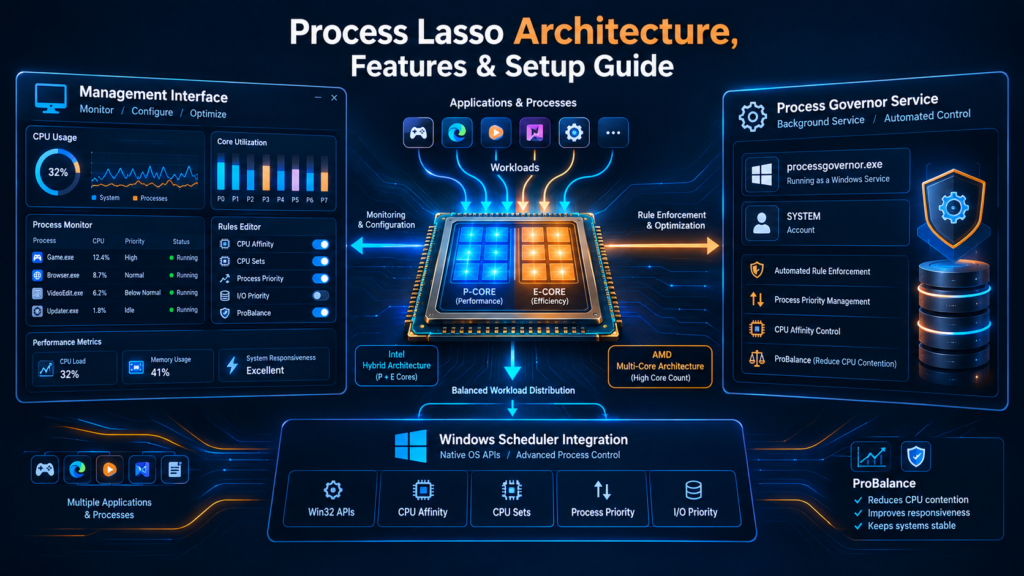
Rather than replacing the Windows scheduler or injecting custom ring-0 kernel drivers, Process Lasso acts as an intelligent companion utility. It monitors active process execution in real time and interacts via standard Win32 and NT executive APIs to apply non-destructive adjustments, ensuring that interactive foreground windows retain priority access to computing resources.
How Does Process Lasso Work Inside Windows?
To understand how process lasso works in Windows and how does process lasso manage processes, it helps to examine its operational architecture and process lasso process automation capabilities.
How Windows Manages Running Processes
Under standard conditions, Windows attempts to share CPU time fairly across all active threads. However, background utilities and updater services frequently execute at normal priority, stealing processor cycles and creating input latency during multitasking.Process Lasso Monitoring and Management Process
The operational workflow of this process management software follows a continuous loop: first, Process Lasso monitors active processes across the operating system; second, it observes real-time resource usage, CPU contention, and thread behavior; third, automated rules are applied dynamically when contention thresholds are reached; and finally, system responsiveness is maintained smoothly across all user sessions.How ProBalance Helps Maintain System Responsiveness
A cornerstone of process lasso functionality is ProBalance explained conceptually: when system CPU utilization spikes due to a background process, ProBalance temporarily restrains the offending application by lowering its priority class slightly. This process lasso responsiveness technology ensures that foreground tasks never experience resource starvation, eliminating system sluggishness without pausing background computations.How to Install Process Lasso on Windows
Executing the process lasso installation guide and following proper process lasso installation steps ensures a clean setup for your PC.
Download the Process Lasso Installer
To begin how to install process lasso, always obtain the verified setup package from official distribution channels to ensure digital signature validity and system security.
Run the Installation Wizard
Launch the downloaded installer executable, review and accept the end-user license agreement, and select your preferred installation directory.
Choose Installation Options
For most beginners, selecting the default installation options (including running the background engine as a system service) provides the ideal configuration. Advanced users can tailor startup parameters and logging behaviors during this step.
Complete Installation and Launch Process Lasso
Once the wizard finalizes file placement, launch the application for the first time to initialize the graphical user interface and activate the background governance service.
What Happens After Installing Process Lasso?
Reviewing process lasso after installation and understanding what happens after installing process lasso helps new users navigate their first launch.
Process Lasso Background Engine Starts
Upon setup completion, the core background engine (processgovernor.exe) initiates automatically. It runs silently under the local SYSTEM account, continuously monitoring process activity alongside Windows without requiring an open graphical window.
Understanding Main Interface Telemetry
The main dashboard provides real-time visibility into active process lists, CPU activity graphs, responsiveness metrics, and application status. Beginners can observe live telemetry without needing to configure complex rules immediately. Learn how to navigate these controls, process lists, graphs, and other interface elements in our Process Lasso Interface guide.
Process Lasso First-Time Setup for Beginners
Mastering process lasso first time setup and getting started with process lasso ensures a smooth experience for users learning how to use process lasso.
Start With Default Settings
New users do not need to make immediate configuration changes. Allowing default automated management to handle thread priorities provides immediate stability out of the box.
Check Automatic Process Management
Verify that the status bar indicates ProBalance is active and monitoring is running normally. This confirms the background governor is actively protecting your system.
Create Rules Only When Needed
Custom rules should be created selectively for specific applications or repeated workloads when advanced optimization is required, avoiding unnecessary manual overrides. To understand how these persistent settings work and remain active across restarts, see Process Lasso Rules.
Recommended Process Lasso Setup for New Users
Following recommended process lasso default settings explained helps maintain system stability during early configuration.
Settings Beginners Should Leave Unchanged
Beginners should avoid making random priority adjustments or altering CPU affinity masks without a specific reason. Understanding baseline system behavior first prevents unintended performance bottlenecks.
When Should You Customize Process Lasso?
Customization is recommended when addressing specific application stutters, managing heavy professional rendering workloads, or optimizing competitive gaming environments
Common Process Lasso Setup Mistakes
Common Process Lasso Setup Mistakes
Changing Too Many Settings Immediately
Over-configuring rules before observing default behavior can disrupt system stability.
Assuming Every Change Improves Performance
Blindly tweaking priorities without identifying true bottlenecks often yields zero benefit.
Creating Rules Without Understanding Their Impact
Applying rigid restrictions on core assignments can starve background applications of required compute time.
Process Lasso Setup Checklist
Follow this quick verification checklist after deployment:
Install Process Lasso from official sources
Launch the application interface
Allow default automation and ProBalance to govern
Check background operation in the system tray
Test normal workloads under daily use
Add custom rules only when required
Frequently Asked Questions About Process Lasso
Conclusion
By serving as an intelligent background process governor, Process Lasso bridges the gap between automated operating system scheduling and granular user control. Following this process lasso guide ensures your computer remains fast, fluid, and responsive under any workload.