
What Are Process Lasso Rules?
Process lasso rules are automated directives assigned to specific executable files that dictate how the operating system handles them whenever they run. By establishing Process Lasso persistent settings across your software ecosystem, these Process Lasso configuration rules and Process Lasso rule settings go beyond default Windows task management by introducing permanent, application-specific governance parameters that survive system reboots.
Microsoft provides detailed information about Windows processes and thread management, which explains how applications interact with system resources. Windows processes and threads documentation
How Do Process Lasso Persistent Rules Work?
How Process Lasso rules work involves understanding that the underlying automation engine operates continuously in the background to monitor active system processes against your defined profile parameters. Learning how to create rules in Process Lasso and how to set permanent rules in Process Lasso empowers you to deploy Process Lasso automatic rules that execute within milliseconds of process initialization.
How to Create and Manage Rules in Process Lasso
Administering custom application behaviors is handled through a centralized interface designed for clarity and rapid configuration. Whether you are setting up new directives or auditing existing policies, understanding the rules manager is vital for maintaining system efficiency.
Understanding the Process Lasso Rules Manager
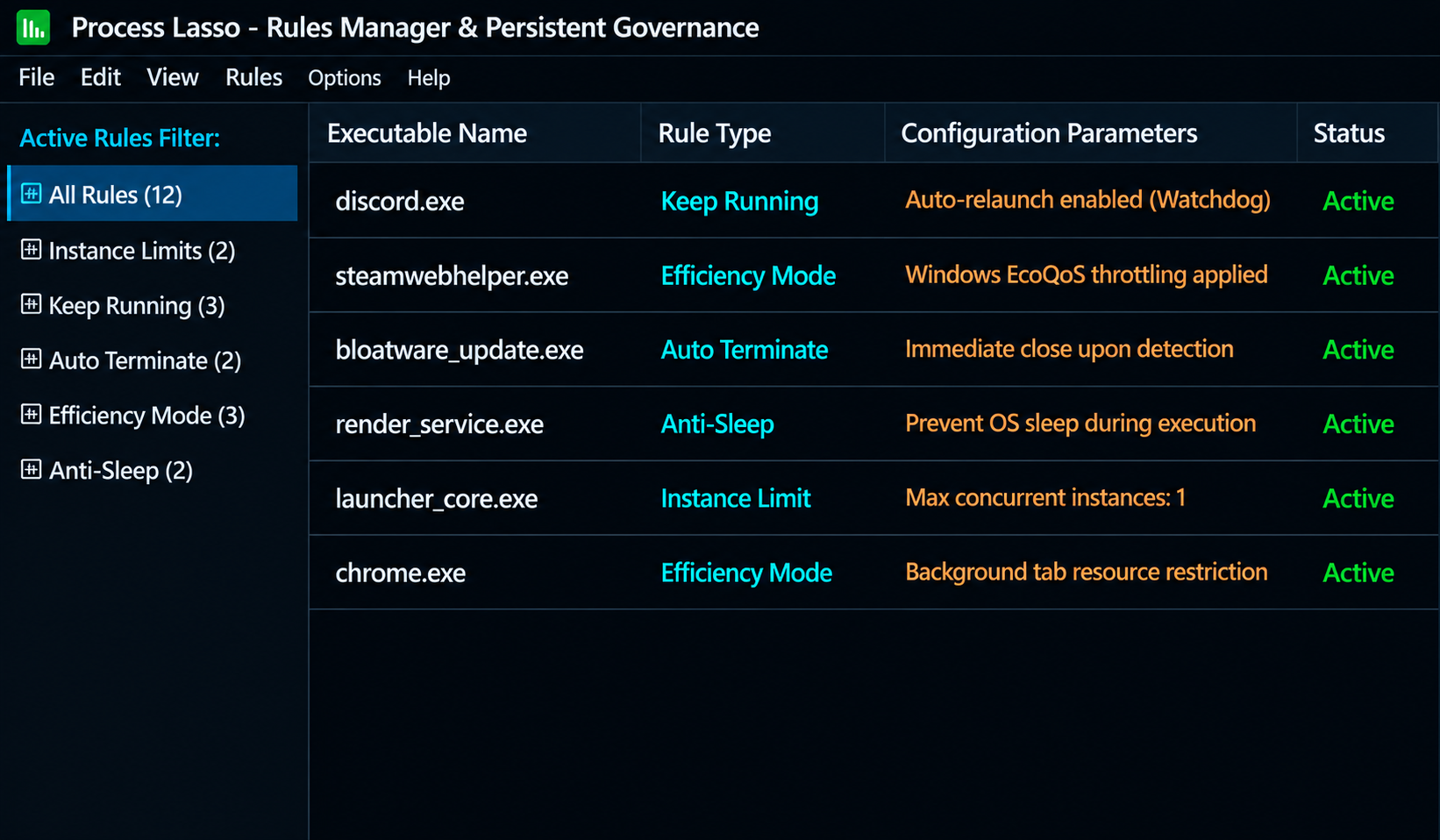
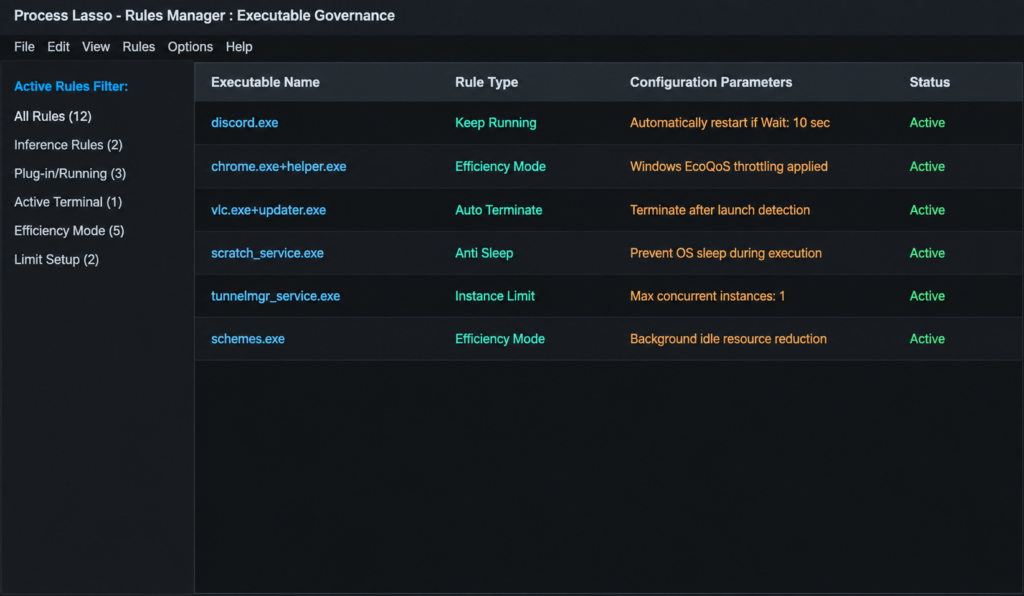
The rules manager serves as the master control center where all active configurations are indexed, sorted, and edited. Users can right-click any active process in the main window to assign persistent parameters, or open the dedicated rules manager from the menu bar to view global directives. This interface displays comprehensive details including target executable names, active parameter types, and specific operational thresholds.
Viewing Active Rules and Rule Symbols
To help operators track active governance at a glance, the interface utilizes specific UI columns and status symbols. Having the Process Lasso rules column explained and Process Lasso rule symbols explained allows you to verify that your thread scheduling and priority management directives are actively executing in real time.
Editing, Resetting, and Removing Process Lasso Rules
Modifying existing governance parameters, utilizing Process Lasso reset rules, or executing Process Lasso remove rules back to Process Lasso default rules requires straightforward navigation through the configuration panel.
Process Lasso Instance Limits Rules
Controlling how many copies of an application can run simultaneously is essential for preventing rogue software loops and runaway resource consumption. Controlling how many copies of an application can run simultaneously is essential for preventing rogue software loops and runaway resource consumption. Users managing multiple application instances can also explore Process Lasso Instance Balancer to understand how workloads can be distributed across available CPU resources.
What Are Instance Limits in Process Lasso? Instance limit rules enforce a strict Process Lasso instance count limit to limit multiple processes Process Lasso executions, effectively acting as a Process Lasso prevent multiple instances mechanism for runaway background scripts.
How to Limit Multiple Instances of a Process Setting an instance count limit involves selecting the target process within the interface (or accessing via Options > Rules Manager > Instance Limits), navigating to its persistent configuration menu, and specifying the maximum allowed copies utilizing Windows NT process handling APIs. Once saved, any subsequent attempt to launch an unauthorized duplicate will be automatically blocked or terminated by the governance engine.
When Should You Use Instance Limit Rules? Instance limits are particularly useful for background utilities, media updaters, or batch scripts that tend to spawn duplicate worker processes during prolonged automated tasks. By capping execution counts, you maintain strict control over background workload regulation and prevent resource starvation.
Process Lasso Keep Running Rules
Maintaining 24/7 uptime for critical background services and monitoring utilities is simplified through automated watchdog directives.
What Does Keep Running Do in Process Lasso?
Keep running rules function as an active watchdog mechanism that monitors specified executables for unexpected crashes or manual closures. If the target process terminates for any reason, the utility immediately triggers a relaunch sequence to restore operation.
How Process Lasso Automatically Restarts Applications
The background monitoring service periodically checks process tables; upon detecting that a protected executable is missing, it executes a clean restart command using the original startup parameters. This automated recovery loop operates independently of Windows Service Control Manager, offering robust resilience for custom desktop tools.
Examples of Processes That Benefit From Keep Running Rules
Critical background applications such as hardware monitoring daemons, custom automation scripts, communication chat clients, and server management utilities benefit immensely from keep running directives. These rules ensure uninterrupted operation during unattended sessions.
Process Lasso Auto Terminate Rules
Eliminating stubborn background bloatware and unauthorized executables is handled efficiently through automated termination protocols.
What Is Auto Terminate in Process Lasso? Auto terminate rules automatically shut down specified background programs the exact moment they appear in the process table, making it easy to manage Process Lasso disallowed processes.
Auto terminate rules automatically shut down specified background programs the exact moment they appear in the process table, making it easy to manage unwanted processes.
For situations requiring stricter resource restrictions instead of process blocking, explore Process Lasso Hard Throttling .
How to Automatically Close Unwanted Processes By designating an executable as an auto-terminate target, you instruct the governor to issue an immediate close signal upon detection. This is ideal for purging annoying startup bloatware, intrusive trialware utilities, or unauthorized gaming launchers.
Auto Terminate vs Disallowed Processes in Process Lasso While auto-terminate rules immediately close processes upon detection, disallowed process configurations often block execution at the kernel level or integrate with security policies. Understanding this distinction helps you choose the right governance method for restricting unwanted software.
Process Lasso Efficiency Mode Rules
Leveraging modern operating system capabilities to suppress non-essential background resource usage helps maintain optimal foreground fluidity. Leveraging modern operating system capabilities to suppress non-essential background resource usage helps maintain optimal foreground fluidity. For additional resource optimization techniques, users can review Process Lasso SmartTrim and its approach to memory efficiency management.
What Is Efficiency Mode in Process Lasso?
Process Lasso Efficiency Mode rules leverage Windows underlying resource throttling APIs—specifically utilizing Microsoft’s native EcoQoS (Efficiency Quality of Service) APIs—to Process Lasso enable Efficiency Mode across Windows 10 and Process Lasso Windows 11 Efficiency Mode environments.
How Efficiency Mode Rules Work With Windows Applications
When an application flagged for efficiency mode runs, the governance engine signals the Windows NT scheduler to treat its threads as low-priority background workloads. This prevents idle utilities from causing micro-stutters during interactive tasks.
When Should You Enable Efficiency Mode Rules?
Enabling efficiency mode is recommended for resource-heavy background tools, cloud synchronization clients, and web browsers left running minimized while you focus on gaming or professional video editing.
Process Lasso Anti-Sleep Rules
Preventing unattended Windows machines from entering sleep or hibernation states during critical operations requires dedicated power override directives.
What Does Anti-Sleep Do in Process Lasso?
Process Lasso Anti Sleep rules override standard Windows power management timeouts to Process Lasso prevent sleep whenever specified applications are actively running in the foreground or background.
How Anti-Sleep Rules Prevent System Sleep
The utility communicates with the Windows power subsystem to assert execution state requirements, preventing the OS from idling into sleep mode while your designated tasks remain incomplete.
Best Use Cases for Anti-Sleep Rules
Anti-sleep rules are indispensable for long-running file transfers, overnight video rendering, large software downloads, and unattended data backups where system interruption would cause data corruption.
Best Process Lasso Rules Settings for Different Use Cases
Tailoring your rule configurations to specific operational scenarios maximizes the utility of automated thread scheduling and priority management. Tailoring your rule configurations to specific operational scenarios maximizes the utility of automated thread scheduling and priority management. Organizations managing multiple machines can combine these practices with Process Lasso Deployment strategies for consistent system configuration.
Process Lasso Rules
for Gaming
Implementing specialized Process Lasso gaming rules alongside Process Lasso FPS optimization settings helps create a friction-free environment: applying keep running rules to essential chat utilities, efficiency mode to background updaters, auto-terminate to intrusive launchers, and anti-sleep during lengthy multiplayer sessions.
Process Lasso Rules
for Background
Applications
For general productivity workstations, background applications benefit from balanced instance limits and efficiency mode assignments, ensuring that auxiliary tools never starve active editing software of necessary computing resources.
Process Lasso Rules
for Long-Running
Tasks
Long-running computational tasks or backups pair perfectly with anti-sleep directives and watchdog keep-running rules, ensuring complete execution without manual supervision or accidental OS power interruptions.
Common Process Lasso Rules Mistakes to Avoid
Avoiding typical configuration pitfalls ensures your automated governance framework remains streamlined, performant, and reliable over time.
Creating Too Many Unnecessary Rules
Setting up excessive rules for every minor background executable can clutter your management interface and complicate troubleshooting. Focus persistent rules only on applications that require specific governance intervention.
Applying Rules to Wrong Applications
Accidentally targeting core system services or critical operating system binaries with restrictive rules can cause system instability. Always verify executable names before assigning permanent automation rules.
Forgetting to Review Old Rules
Failing to periodically audit your rule list leads to orphaned directives for uninstalled software. Regular reviews keep your configuration clean and fully optimized.
Frequently Asked Questions About Process Lasso Rules