
Why Users Look for Process Lasso Alternatives
Process Lasso functions as an advanced automation utility designed to manage Windows thread priorities, mitigate CPU contention, and optimize responsiveness via its proprietary ProBalance algorithm and background governor service (processgovernor.exe). Operating under the SYSTEM account via the Windows Service Control Manager, it applies persistent rules stored in prolasso.ini located within C:\ProgramData\ProcessLasso\config\.
Despite its robust capabilities, users frequently explore software like Process Lasso or programs similar to Process Lasso due to varying feature requirements, budget constraints, preferences for simpler interfaces, or the need for specialized hardware-level CPU tuning rather than automated background governance.
Key Features That Make Process Lasso Popular
The primary appeal of Process Lasso lies in its sophisticated automation framework, which includes ProBalance dynamic priority management, customizable process rules, CPU affinity control, and performance mode toggles. These features allow advanced administrators and gamers to prevent thread starvation and maintain consistent frame pacing during heavy workloads.
By combining real-time telemetry display with a headless background service, Process Lasso delivers proactive performance optimization that surpasses the capabilities of native Windows utilities.
Reasons Users Search for Process Lasso Alternatives
Users search for the best Process Lasso alternatives for several practical reasons. Some operators look for entirely free solutions without feature gates, while others require lightweight monitoring utilities that focus strictly on process inspection without automated rule enforcement.
Additionally, users seeking direct hardware-level frequency scaling or core parking adjustments often investigate specialized alternatives tailored precisely to specific CPU architectures.
How We Selected the Best Process Lasso Alternatives
Selecting the best Process Lasso replacements requires evaluating competing utilities against rigorous standards encompassing process management depth, CPU optimization power, user interface design, and licensing models. Each candidate software is assessed based on its ability to solve real-world performance bottlenecks. For users managing multiple systems or enterprise environments, understanding software rollout requirements through Process Lasso Deployment can help evaluate long-term management needs.
This selection methodology ensures that recommended tools provide genuine utility, whether users require advanced process auditing, power management, or full PC maintenance.
Process Management Features
Process management evaluation focuses on a tool’s capability to monitor active processes, inspect thread stacks, adjust priority classes, and handle background application execution reliably without impacting system stability.
CPU and Resource Optimization Capabilities
Resource optimization assessment examines how effectively each alternative manages CPU core assignment, frequency scaling, power states, and contention mitigation across multi-core hardware architectures.
Users comparing different CPU control approaches can also explore Process Lasso CPU Limiter to understand how automated processor usage management helps control demanding workloads.
Ease of Use and System Compatibility
System compatibility and usability criteria ensure that recommended alternatives offer accessible learning curves, stable operation across modern Windows versions, and clean user interfaces suitable for both novices and experienced IT professionals.
Pricing, Free Versions, and Licensing Options
Licensing analysis compares free open-source utilities against commercial applications, evaluating trial limitations, subscription models, and permanent perpetual purchase options to accommodate every budget.
Process Lasso Alternatives Compared
Evaluating the top seven alternatives reveals distinct software categories designed to address specific optimization needs. From dedicated power management utilities to advanced system monitors and full PC maintenance suites, each tool offers a unique approach to Windows performance tuning.
Comparing these applications side-by-side clarifies their operational strengths and helps users select the ideal tool for their individual workflow requirements.
1. ParkControl – Best Alternative for CPU Power Management
ParkControl is developed by Bitsum, the creators of Process Lasso, but it focuses exclusively on CPU core parking management and power plan optimization. It provides a streamlined interface for tweaking processor power states without the broader process automation features found in its sister software.
What Is ParkControl? ParkControl is a dedicated utility designed to control Windows core parking algorithms and active power profiles. Core parking dynamically disables idle CPU cores to save energy, but re-enabling them during sudden workloads can introduce latency spikes. ParkControl allows users to adjust or disable core parking instantly.
ParkControl vs Process Lasso While ParkControl concentrates exclusively on CPU power management and core parking adjustments, Process Lasso serves as a comprehensive process optimization suite featuring ProBalance automation, custom rules, and background throttling engines. Users interested in Windows power behavior, energy efficiency, and automated performance profiles can review Process Lasso Power Management to learn how power settings influence system responsiveness.
ParkControl Features, Pros and Cons ParkControl features real-time core parking status displays, dynamic power plan adjustments, and system tray integration. Its primary advantages include lightweight operation and absolute simplicity, while its main limitation is the absence of advanced process management rules.
Who Should Use ParkControl? ParkControl is best suited for users and gamers who specifically want to manage CPU core parking and power profiles without installing a full-fledged background process governor.
2. QuickCPU – Best Alternative for CPU Core and Performance Tuning
QuickCPU is an advanced hardware-level utility designed to monitor and control CPU performance, core parking, frequency scaling, and voltage parameters. It offers deep inspection and tuning controls for enthusiast hardware.
What Is QuickCPU?
QuickCPU provides granular hardware telemetry and real-time adjustment capabilities for processor performance counters, core status, and power delivery metrics, giving power users direct oversight of CPU behavior.
QuickCPU vs Process Lasso
QuickCPU focuses primarily on hardware-level CPU tuning, thermal monitoring, and core performance metrics, whereas Process Lasso concentrates on application-level thread scheduling, priority management, and automated background governance.
QuickCPU Features, Pros and Cons
QuickCPU offers detailed core performance graphs, frequency control sliders, and power profile customization. Its strengths lie in deep hardware metrics, though its complex technical interface may overwhelm casual users.
Who Should Use QuickCPU?
QuickCPU is ideal for hardware enthusiasts and overclockers who require direct control over processor core performance, frequency scaling, and power delivery characteristics.
3: Process Explorer – Best Free Microsoft Alternative
Process Explorer is an advanced, free diagnostic utility developed by Microsoft Sysinternals. It serves as a powerful replacement for the standard Windows Task Manager, offering deep process inspection and DLL tracking capabilities.
Process Explorer provides detailed visibility into running processes, resource usage, and system activity for advanced Windows troubleshooting. Microsoft Process Explorer documentation
What Is Process Explorer? Process Explorer displays a hierarchical view of all running processes, highlighting parent-child relationships, open file handles, loaded DLLs, and real-time resource consumption graphs for advanced system troubleshooting.
Process Explorer vs Process Lasso Process Explorer is fundamentally a diagnostic and monitoring tool designed for manual troubleshooting and inspection, whereas Process Lasso is an automated optimization engine that enforces persistent rules and background governance.
Process Explorer Features, Pros and Cons Process Explorer features hierarchical process trees, VirusTotal integration for executable verification, and detailed handle searching. Its main advantage is being a free, authoritative Microsoft utility, though it lacks automated optimization algorithms.
Who Should Use Process Explorer? Process Explorer is best for IT administrators, developers, and advanced users who need a robust, free diagnostic tool to investigate running applications and system handles.
“`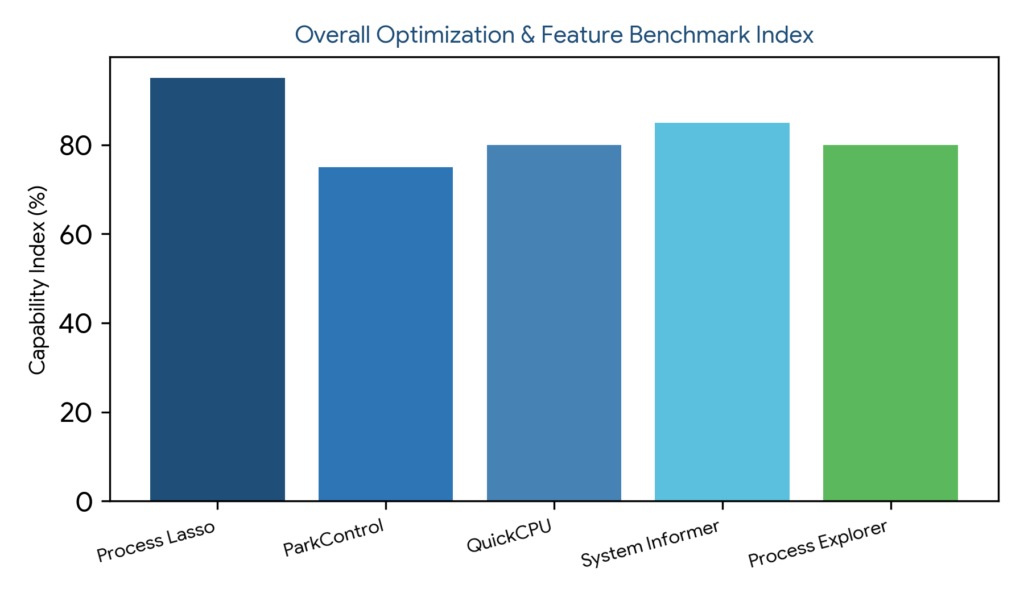
Figure 1: Overall optimization and feature benchmark index comparison across Process Lasso, ParkControl, QuickCPU, System Informer, and Process Explorer.
4. System Informer – Best Alternative for Advanced Process Management
System Informer is a feature-rich, open-source process monitor and system analysis tool that provides comprehensive visibility into system resource utilization, network activity, and process security attributes.
What Is System Informer?
System Informer serves as a modern successor to Process Hacker, offering deep system inspection, kernel-level driver debugging capabilities, detailed memory map visualization, and real-time performance graphs.
System Informer vs Process Lasso
System Informer excels at deep process inspection, debugging, and manual system monitoring, while Process Lasso specializes in automated background optimization, priority adjustments, and persistent rule enforcement.
System Informer Features, Pros and Cons
System Informer offers granular process tracking, network connection inspection, service management, and open-source flexibility. Its primary benefit is unmatched diagnostic depth, though it requires technical familiarity to navigate effectively.
Who Should Use System Informer?
System Informer is best for advanced power users, security analysts, and system administrators who require open-source, low-level process inspection and debugging tools.
5. System Explorer – Best Alternative for System Monitoring
System Explorer is a user-friendly application designed to monitor running processes, system startup entries, connections, and file security scanning via integrated online databases.
What Is System Explorer?
System Explorer provides a clean interface for tracking system activity, comparing snapshots of system files and registry entries, and monitoring real-time performance metrics with minimal resource overhead.
System Explorer vs Process Lasso
System Explorer emphasizes system auditing, file snapshot comparisons, and process telemetry, whereas Process Lasso focuses on active background performance governance and dynamic priority balancing.
System Explorer Features, Pros and Cons
System Explorer features snapshot comparison tools, security check integrations, and modular monitoring tabs. Its pros include a clean interface and comprehensive auditing, while its cons include infrequent modern updates.
Who Should Use System Explorer?
System Explorer is suitable for users looking for a traditional multi-tabbed monitoring utility to audit startup items and inspect active running applications.
6. System Mechanic – Best Full PC Optimization Alternative
System Mechanic is a comprehensive commercial PC maintenance and optimization suite designed to clean junk files, repair registry errors, boost internet speeds, and improve overall system health.
What Is System Mechanic?
System Mechanic provides an all-in-one maintenance toolset that automates disk cleanup, startup optimization, memory reclamation, and privacy protection across the entire operating system.
System Mechanic vs Process Lasso
System Mechanic focuses on whole-PC maintenance, disk cleanup, and registry repair, whereas Process Lasso concentrates specifically on real-time CPU thread scheduling, process priority management, and contention mitigation.
System Mechanic Features, Pros and Cons
System Mechanic offers automated system maintenance, junk file removal, and performance acceleration tools. Its advantage is all-in-one convenience, though its commercial subscription model and heavy feature set contrast with Process Lasso’s targeted focus.
Who Should Use System Mechanic?
System Mechanic is best for users seeking a comprehensive, automated maintenance suite to clean and maintain overall computer health.
7. Windows Task Manager – Best Free Built-In Alternative
Windows Task Manager is the default, built-in system monitoring and process management utility included natively with every Windows operating system installation.
Windows Task Manager provides essential process monitoring, resource utilization graphs, startup application management, and basic priority adjustment controls without requiring third-party software downloads.
Windows Task Manager offers basic, manual process monitoring and termination controls, whereas Process Lasso delivers advanced background automation, persistent rules, and dynamic ProBalance optimization.
Task Manager features zero installation overhead, native OS integration, and straightforward resource tracking. Its pro is universal availability, while its con is the complete lack of persistent rules and background automation.
Windows Task Manager is ideal for casual users who need basic task monitoring and application termination without installing specialized third-party utilities.
| Software | Best For | Process Management | CPU Optimization | Automation | Price |
|---|---|---|---|---|---|
| Process Lasso | Advanced Automation | Advanced | Advanced | Yes | Freemium / Paid |
| ParkControl | Power Management | Basic | Advanced (Parking) | Limited | Free / Pro |
| QuickCPU | Hardware CPU Tuning | Moderate | Advanced (Core/Freq) | Limited | Free / Pro |
| System Informer | Advanced Monitoring | Advanced | Moderate | No | Free (Open-Source) |
| Process Explorer | Free Diagnostics | Advanced | Basic | No | Free (Microsoft) |
| System Mechanic | Full PC Maintenance | Moderate | Moderate | Yes | Paid Subscription |
| Windows Task Manager | Basic Monitoring | Basic | Basic | No | Free (Built-in) |
Process Lasso Alternatives: Which One Should You Choose?
Choosing the right tool depends entirely on your specific performance goals and technical requirements. While Process Lasso remains the gold standard for automated background governance, alternative utilities cater to narrower optimization focuses.
Matching your workflow requirements to the appropriate software ensures optimal system tuning without unnecessary complexity or resource overhead. Before switching tools or changing optimization workflows, reviewing the latest Process Lasso Changelog and release notes can help users understand recent feature updates.
Choose Process Lasso If You Need Advanced Automation
Process Lasso is the ideal choice if you require persistent process rules, automated ProBalance priority management, and long-term background optimization that runs without manual intervention.
Choose ParkControl If You Need Power Management Optimization
ParkControl is recommended when your primary objective is tweaking CPU core parking algorithms and managing Windows power plans through a lightweight, dedicated interface.
Choose QuickCPU If You Need CPU Tuning Controls
QuickCPU suits enthusiasts who want deep hardware-level telemetry, frequency scaling controls, and core performance monitoring without complex background automation rules.
Choose System Informer If You Need Advanced Monitoring
System Informer is best for users seeking a powerful, open-source diagnostic monitor to inspect thread stacks, debug processes, and analyze low-level system activity.
Choose Process Explorer If You Need a Free Microsoft Tool
Process Explorer serves as the premier free Microsoft utility for tracking process trees, verifying digital signatures via VirusTotal, and troubleshooting handle locks.
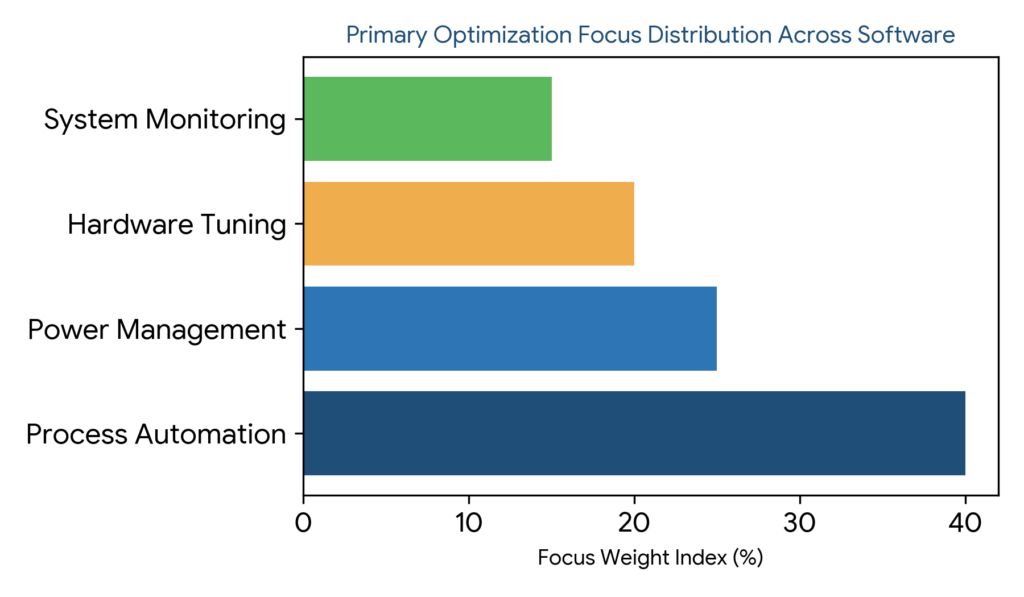
Figure 2: Primary optimization focus distribution across process automation, power management, hardware tuning, and system monitoring software categories.
Frequently Asked Questions About Process Lasso Alternatives

One Comment